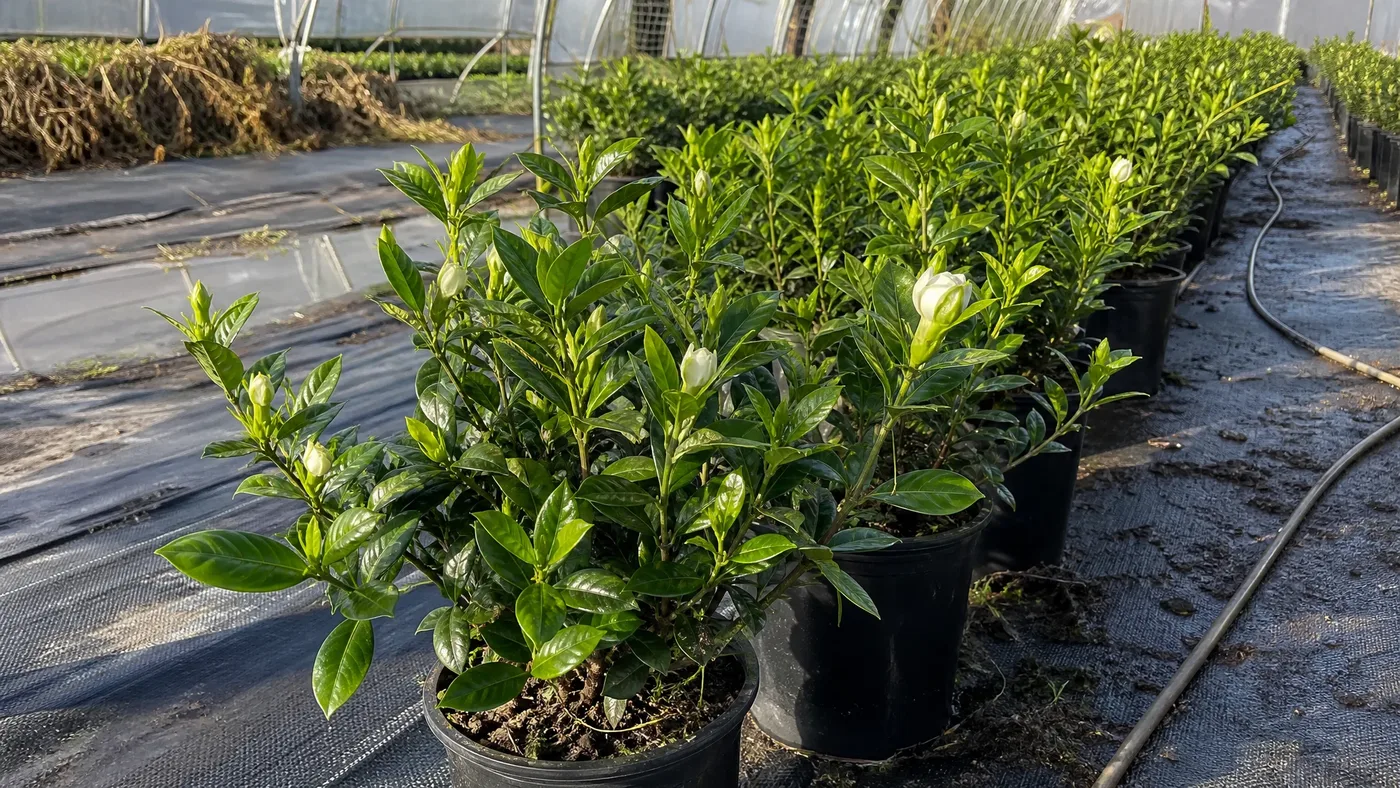
Kleim's Hardy Gardenia vs Jubilation Gardenia: Size and Hardiness
Picture two labeled flats of rooted cuttings on a propagation bench, one tagged Kleim's Hardy and one tagged Jubilation. Each tag carries a count of days to root and a ruler reading taken at the same six-week mark. At that stage the two flats look almost the same.
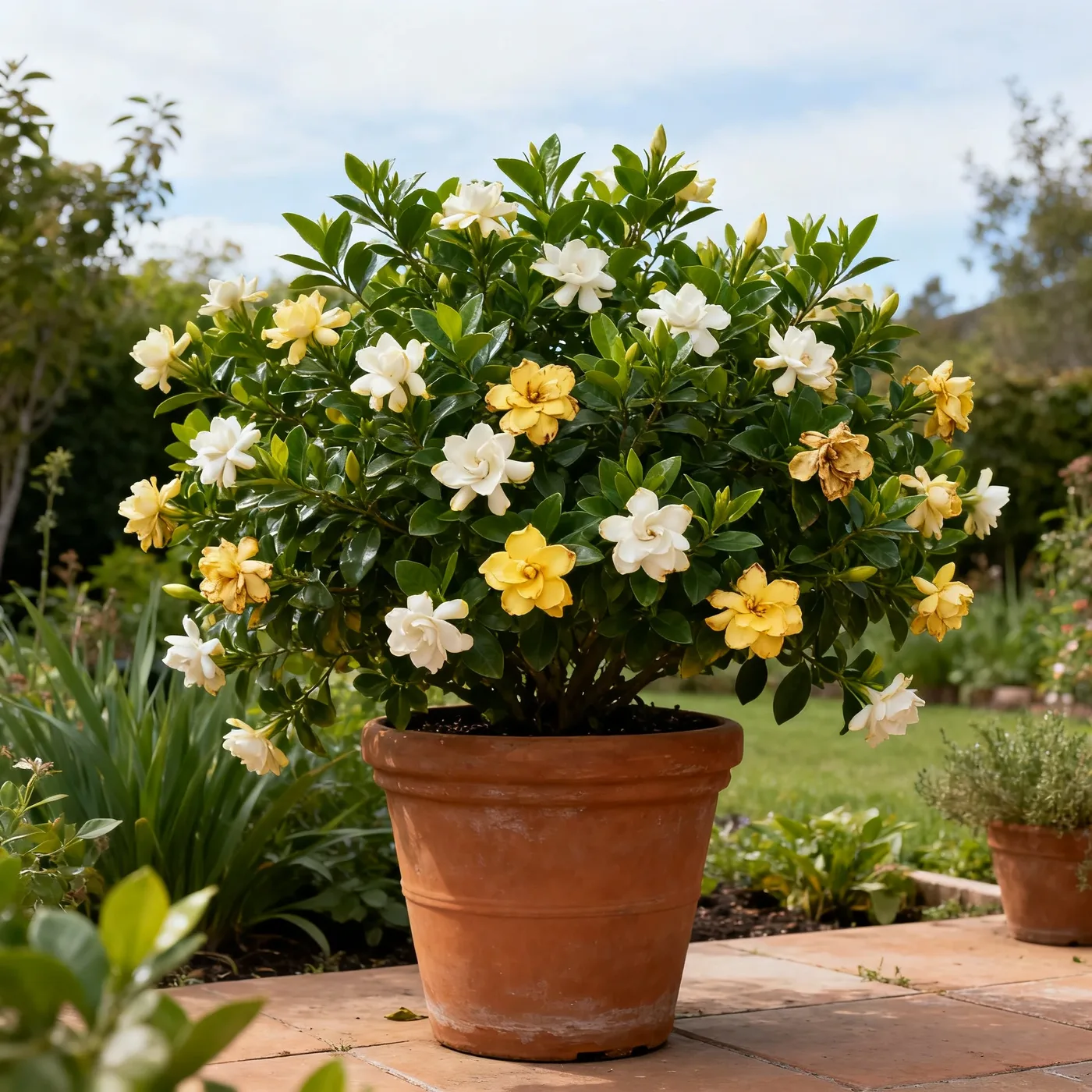
Many buyers assume the two gardenias are interchangeable because they show up on the same cold-hardy lists. What we see instead is a gap that opens in the pot and keeps widening in the ground. Kleim's Hardy stays at about 2–3 feet, while Jubilation climbs to 3–4 feet.
This article talks about size, growth speed and cold tolerance for both gardenias and answers the questions customers ask us most. Read on to learn how each one grows from cutting to mature shrub, what a hard freeze does to them, how they recover from tip dieback, and which one we would put in your bed.
Two Rooted Cuttings in One Flat
On every flat tag we record three readings: the cutting length at sticking, the days until roots form, and the height at six weeks. We are not printing those numbers here. They swing with bench heat and season, and a figure we cannot tie to a published source would only mislead you. What we can give you is what the readings tell us.
The main lesson is that early numbers do not predict final size. In our flats the two cultivars are hard to tell apart at six weeks. The divergence comes later, because Kleim's Hardy is a slow grower and Jubilation grows at a medium rate.
Both come from Gardenia jasminoides, a species that reaches 4–8 feet tall and wide. Both are selections bred well below that. Many newer, smaller gardenia cultivars are hardy to at least zone 7a, but dwarf cultivars are often more cold sensitive. Smaller does not automatically mean tougher, and that caution comes up again in the freeze section.
Here is what we write on a flat tag, and why each reading matters:
- Cutting length at sticking tells us whether a slow rooting time came from weak material or from the cultivar itself.
- Days to root tells us when a flat can move to pots, and it varies more with bench temperature than with cultivar.
- Height at six weeks is a baseline only, because a fast start in the flat has not predicted a taller mature shrub for either gardenia.
Kleim's Hardy Gardenia Fills Its First Gallon Pot
Kleim's Hardy is the slower of the two. Its growth rate is slow, and the first container stage shows it. Roots take their time reaching the pot wall, and top growth stays tight and dense instead of stretching.
We do not quote inches per season here, because no published source gives them for either cultivar. What you can plan on is patience. A slow cultivar needs more months in each pot size, so we would not hurry it with heavy feeding. Pushing soft growth with extra nitrogen is the usual way to end up with weak tips that the first cold snap burns.
If leaves in the pot turn yellow while the veins stay green, check pH before you reach for fertilizer. This cultivar needs acid soil, below 6.0, and a potting mix that has drifted above that stops the roots taking up iron. Evenly moist mix and an acid pH fix more yellow gardenias than any feeding schedule.
The compact size also suits containers, small spaces and the edge of a patio or walkway. We grow Kleim's Hardy to a full gallon pot and wait until the roots reach the sides before we call it ready. Our container sizes guide explains what to look for when you buy.
Jubilation Pulls Ahead Once Planted Out
In the ground the medium growth rate of Jubilation starts to show. It matures at 3 to 4 feet tall and 3 feet wide. Kleim's Hardy matures at 2–3 feet, and Clemson rounds it to 3 feet tall and wide. The height difference is real, and it is up to about a foot.
Width is where the roundups mislead. Several describe Jubilation as spreading much wider than Kleim's Hardy. The actual figure for Jubilation is 3 feet wide, which matches the top of the Kleim's Hardy range. If you are choosing on width alone, the two are close. Choose on height and speed.
Flowers Differ Too
Jubilation carries double flowers in late spring and reblooms from summer into fall. Kleim's Hardy has single flowers in summer. That changes the look of a bed more than the extra foot of height does, so decide which flower form you want before you decide on size.
What Slow Growth Means After Planting
A slow cultivar costs you a few seasons before the shrub fills its space, and some customers read that as failure. If a newly planted Kleim's Hardy is barely taller after its first year, check three things in order: soil pH, steady moisture, and planting depth. Our size and growth rate guide covers the pace in more detail.
The First Hard Freeze Tests Both Shrubs
Clemson lists Kleim's Hardy as hardy to 10°F. Jubilation is cold hardy to zone 7a but may suffer leaf burn during a cold winter. Neither source gives a lowest survivable temperature for Jubilation, and we will not invent one. We do not quote trial lows of our own, so use the table below as the published picture.
| Plant | Zones listed | Cold note from the source |
|---|---|---|
| Kleim's Hardy | 7a through 11b | Hardy to 10°F |
| Jubilation | Hardy to 7a | May suffer leaf burn in a cold winter |
| Species, G. jasminoides | 7b through 11b | Older cultivars hardy to zone 8 |
The leaves and soft tips fail first in a gardenia. They are the youngest, least hardened tissue, and they brown before the woody stems are hurt. Browned leaves after a freeze are a warning, not a verdict. Do not cut anything the same week, because the damage line is not clear yet.
A zone 7a rating means the plant is listed there, not that every winter in 7a is safe. Jubilation's leaf burn note is the honest version of that. If your winters swing between mild and hard, mulch the root zone and shelter the shrub from wind. Our winter care guide gives the steps in order.
What Kleim's Hardy Gardenia Does After Tip Dieback
After a freeze, the question we hear most is whether the plant is dead. Wait for spring and let the plant show you. Kleim's Hardy, being slow, takes longer to push new growth than Jubilation does. Jubilation recovers faster but has more height and leaf area to lose.
We have no midsummer height readings from published sources to hand you, so judge recovery by what the shrub does. By midsummer you should see new shoots covering most of the pruned tips. If a branch is still bare then, it is dead wood and can come out. Work through the steps below in order.
- Wait until new growth appears in spring before judging any stem.
- Cut browned tips back to live green wood, just above a healthy leaf pair.
- Leave stems alone if they flex and show green under the bark.
- Keep the soil evenly moist and skip heavy feeding until new leaves harden.
- If the new leaves come in pale, test pH before assuming cold is the cause.
Gardenias that were stressed by dry soil the previous summer fare worse in a freeze. Customers usually ask us whether a second dieback means they chose the wrong cultivar. Often it means the shrub went into winter underwatered. Our pruning guide covers where to make the cuts.
Mature Height and Width of Kleim's Hardy Gardenia
The published sources give mature sizes, not a count of years, so treat the ten-year picture as a range. Kleim's Hardy reaches 2–3 feet tall and 2–3 feet wide. The species, by contrast, runs 4–8 feet tall and wide. At its 3 ft maximum, the cultivar is under 40% of the species' 8 ft top size, closer to a third than to half.
A slow grower may take many seasons to reach those figures, and sun, soil and moisture all move the result. Ask your local extension service what established gardenias reach in your area. Where our numbers and a local report differ, trust the local one.
| Plant | Mature height | Mature width | Source |
|---|---|---|---|
| Kleim's Hardy | 2–3 feet | 2–3 feet | NC State |
| Kleim's Hardy | About 3 feet | About 3 feet | |
| Jubilation | 3–4 feet | 3 feet | |
| Species | 4–8 feet | 4–8 feet | NC State |
Read the two Kleim's Hardy rows together: expect 2–3 feet, and allow that a well-grown plant can reach 3. For Jubilation, plan on the upper end of 4 feet if the bed is close to a path or window.
Which Bed Each Gardenia Fits
We would choose Kleim's Hardy for most readers. It suits a small foundation bed, a pot by the door, or a walkway edge where a shrub that outgrows its space becomes a pruning chore. It also carries the only published 10°F rating of the two, and that number matters more than size if your winters are hard.
We would choose Jubilation for a specimen planting or the back of a border in zone 7a or warmer, where the extra foot of height helps. Accept the leaf burn risk that comes with a cold winter. Its double flowers and rebloom into fall are a real reason to pick it. Do not plant it where a cold winter would leave it bare and exposed.
If you are comparing beyond these two, our hardiness zones guide shows where Kleim's Hardy is listed to survive.
Kleim's Hardy Gardenia Numbers to Plan Around
The numbers that matter are few. Kleim's Hardy is listed for zones 7a through 11b, hardy to 10°F, and 2–3 feet tall and wide. Jubilation is listed to zone 7a, may burn in a cold winter, and reaches 3–4 feet tall and 3 feet wide. Slow against medium growth explains most of the gap you will see in the ground.
The two lines to remember are these. Kleim's Hardy stops being a safe bet below 10°F and above 3 feet. Jubilation stops being a safe bet below the zone 7a range and above 4 feet.
Kleim's Hardy Gardenia
Nursery-grown Kleim's Hardy Gardenia in sizes from 2 Quart, shipped to your door.
From $15.95
Shop Now →We grow Kleim's Hardy in acid, moist but well-drained soil on our own farms. Before a plant leaves us, we check its roots and leaf color, because a compact shrub only stays compact if it starts healthy. We are a small team of growers raising top-quality shrubs, and one of them could be the next shrub in your garden.